
![Nollywood actor CJay Nwoks dies in Lagos hospital [VIDEO]](https://primenewz.ng/wp-content/uploads/2026/09/CJAY-WOKS.jpeg)
The Universal Basic Education Commission (UBEC) has renovated more than 4,000 classrooms and commenced the implementation of a whole-school approach in over 287 schools nationwide as part of efforts to improve the quality of public basic education.
Executive Secretary of UBEC, Dr Aisha Garba, disclosed this on Wednesday in Abuja during an inspection tour of renovated schools and newly commissioned digital learning centres in the Federal Capital Territory.
Garba said the commission had moved away from isolated interventions, such as renovating individual classrooms or providing limited furniture, insisting that government interventions must address the overall needs of schools.
She said the new minimum standards developed by UBEC required federal, state and local governments to assess the needs of an entire school before embarking on construction or rehabilitation projects.
According to her, the whole-school approach covers classrooms, furniture, toilets, water supply, electricity, fencing, security and digital learning infrastructure.
“We are no longer going to renovate a window, or put in one chair and leave hundreds of students sitting on the floor.
“Today, our renovation based on the minimum standards is called the Whole School Approach. This means any school that government is going to renovate, whether it is federal, state or local government, must follow that minimum standard,” she said.
Garba explained that, under the approach, officials would identify all infrastructural and learning gaps in a school and ensure that they were addressed as part of a single intervention.
She said schools without fencing would be fenced, those without water would be provided with boreholes, while schools without electricity would receive solar power systems.
“Not only to put in solar, but they should also put in burglar-proofing, as we have seen today here, under the digital learning centres,” she added.
The UBEC boss said the commission had also made its intervention funds accessible to states to enable them to replicate and scale up the whole-school model across states and local government areas.
On digital learning, Garba said UBEC had commissioned 74 digital learning centres during the inspection exercise, bringing the number established under the current administration to more than 2,000.
She said the centres were designed as comprehensive digital learning facilities, rather than merely computer laboratories.
According to her, the centres are equipped with computers, smart boards, printers, scanners, internet connectivity, solar power, burglar-proofing and online and offline learning content for both teachers and pupils.
She added that teachers would also be trained to effectively use the digital learning facilities and content.
Garba said the whole-school approach and digital learning initiatives were part of efforts to ensure that children remained in school and had access to a safe and conducive learning environment equipped with 21st-century technology.
“Under the Renewed Hope Agenda of our President Bola Ahmed Tinubu, our directive was very clear: ensure that no child is left behind regardless of where he is.
“If he is out of school, we must bring him back to school. If he is in school, we must ensure that he learns in a conducive, safe environment and also has the necessary 21st-century technology,” she said.
She said the model was being scaled up nationally through UBEC and state governments, noting that enforcing minimum standards remained one of the commission’s key mandates.
Garba said the approach would end the practice of constructing isolated classroom blocks without considering other critical requirements, such as security, water, sanitation and learning facilities.
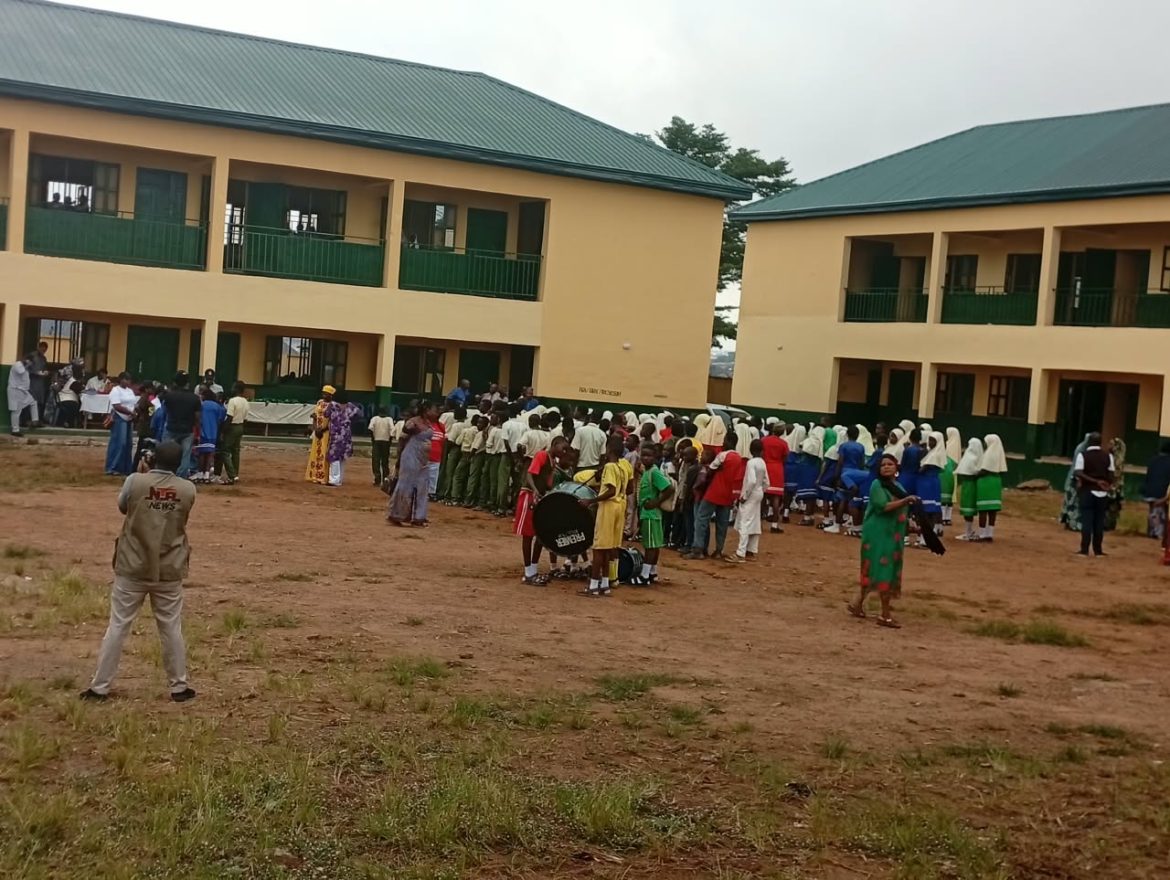
During the inspection, the UBEC team visited the Primary and Government Junior Secondary School, Nyanya Hausawa, in Abuja Municipal Area Council, as well as Model Girls’ Junior Secondary School, Aco Estate, Lugbe.
Speaking on the condition of the Nyanya Hausawa school before the intervention, UBEC Director of Physical Planning, Arch. Nura Ibrahim, said the school was located in a remote, forested area and had suffered serious infrastructural deficiencies.
He said a condition assessment was conducted before the intervention to determine the extent of rehabilitation required.
“The first thing we observed was that some of the buildings were completely defective and had lost their structural integrity. Some of the classrooms were unsafe. The beams were cracked, and some parts had already fallen apart,” Ibrahim said.
The Principal of the school, Gideon Isah, described the commissioning of the renovated facilities as a historic occasion, saying the intervention had transformed the learning environment.
Isah recalled that some pupils previously sat on bare floors because of inadequate furniture.
He said the renovation had improved the mood of teachers and pupils, while the school community, in collaboration with the Parent-Teacher Association, had employed three security personnel to protect the newly renovated facilities from vandalism.
While appreciating UBEC for the intervention, the principal appealed for the construction of an administrative block, noting that the premises housed three schools — primary, junior secondary and senior secondary — which lacked an administrative building.