




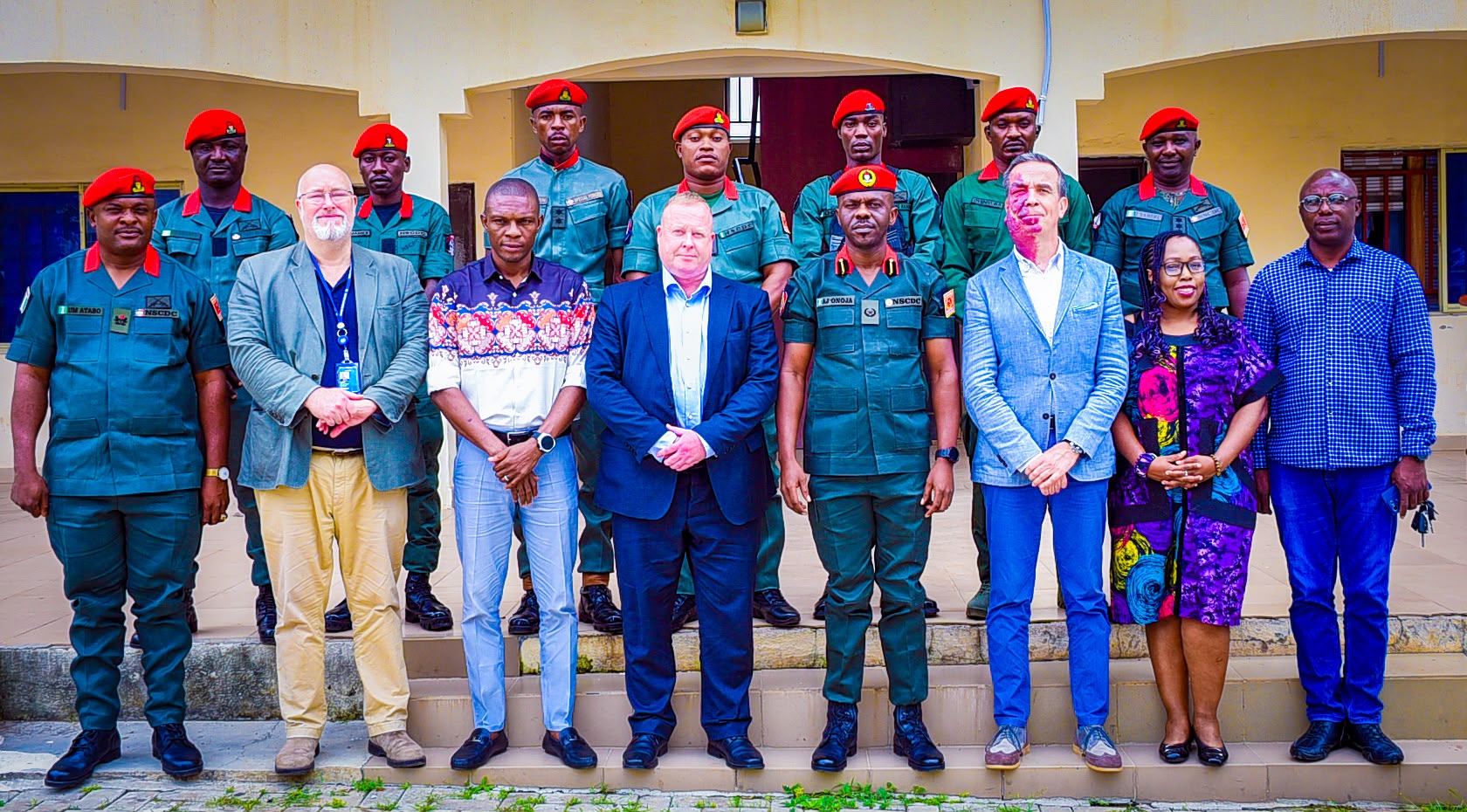
The United Nations Office on Drugs and Crime (UNODC) has intensified its engagement with Nigeria Security and Civil Defence Corps (NSCDC) Mining Marshals, as concerns grow over the links between illegal mining, organized crime and terrorism across West Africa and the Sahel.
During a strategic visit to the Mining Marshals Corps (MMC), a UNODC delegation led by Mr. Tullio Santini, Chief of the Africa Section of the Terrorism Prevention Branch (TPB), praised the specialized enforcement unit for its expanding role in combating illegal mining, citing a rising number of arrests and prosecutions as evidence of Nigeria’s commitment to tackling the illicit trade.
The visit formed part of a broader UNODC mission aimed at strengthening partnerships across Nigeria, engaging development partners, and reviewing ongoing field operations.
Central to the discussions was the introduction of the UNODC CONNECT Initiative by Mr Robert Haslinger, Law Enforcement expert from the Swedish Police. The Coordination through Operational Networks against the Crime-Terrorism Nexus (CONNECT) is a strategic framework designed to enhance cooperation among governments and law-enforcement agencies in dismantling financial and operational links between organised criminal networks and terrorist groups. The initiative is scheduled for launch in November 2026, with Nigeria among the countries invited to participate.
Responding on behalf of the Commandant General of the Nigeria Security and Civil Defence Corps (NSCDC) Prof. Ahmed Abubakar Audi mni OFR, the Commander of the Mining Marshals, Assistant Commandant of Corps (ACC) John Onoja Attah, welcomed the UNODC delegation and described the organisation as a critical partner in strengthening the unit’s operational capabilities.
He noted that previous UNODC-supported training programmes had significantly improved collaboration between the Mining Marshals and the Nigerian Financial Intelligence Unit (NFIU), enhancing the ability of both institutions to coordinate investigations and intelligence-led operations against illegal mining syndicates.
The commander explained that the Mining Marshals occupy a unique position within Nigeria’s security architecture, reporting to the Ministry of Interior, the Ministry of Solid Minerals Development, and the NSCDC. While their primary mandate remains the suppression of illegal mining activities, the officers—drawn from the NSCDC—also support broader national security operations when required.
Mr. Onoja used the meeting to advocate for the formal inclusion of the Mining Marshals in the CONNECT Initiative, arguing that disrupting the financial foundations of terrorist organizations requires greater attention to the illegal exploitation of mineral resources.
According to him, the nexus between illegal mining and terrorism has become increasingly relevant to Nigeria’s national security calculations and partly explains the Federal Government’s ongoing reforms in the mining sector, where the Mining Marshals have emerged as a key enforcement instrument.
He further requested expanded capacity-building programmes focused on terrorism-related concepts, regional intelligence cooperation, and peer-learning opportunities that would strengthen the unit’s ability to address evolving threats linked to illicit mining operations.
UNODC officials commended the institutional structure of the Mining Marshals, describing it as a notable model within Nigeria’s law-enforcement ecosystem. They observed that the unit possesses an unusually broad operational mandate, enabling it to manage illegal mining cases from intelligence gathering and prevention through arrest, investigation and prosecution, while also employing non-kinetic approaches such as stakeholder engagement and
community outreach.
The meeting concluded with the exchange of publications, a commemorative photograph session, and renewed commitments to collaboration in confronting the growing convergence of resource crime and terrorism across the region.