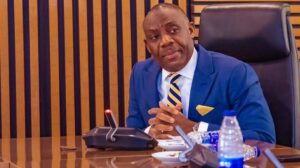


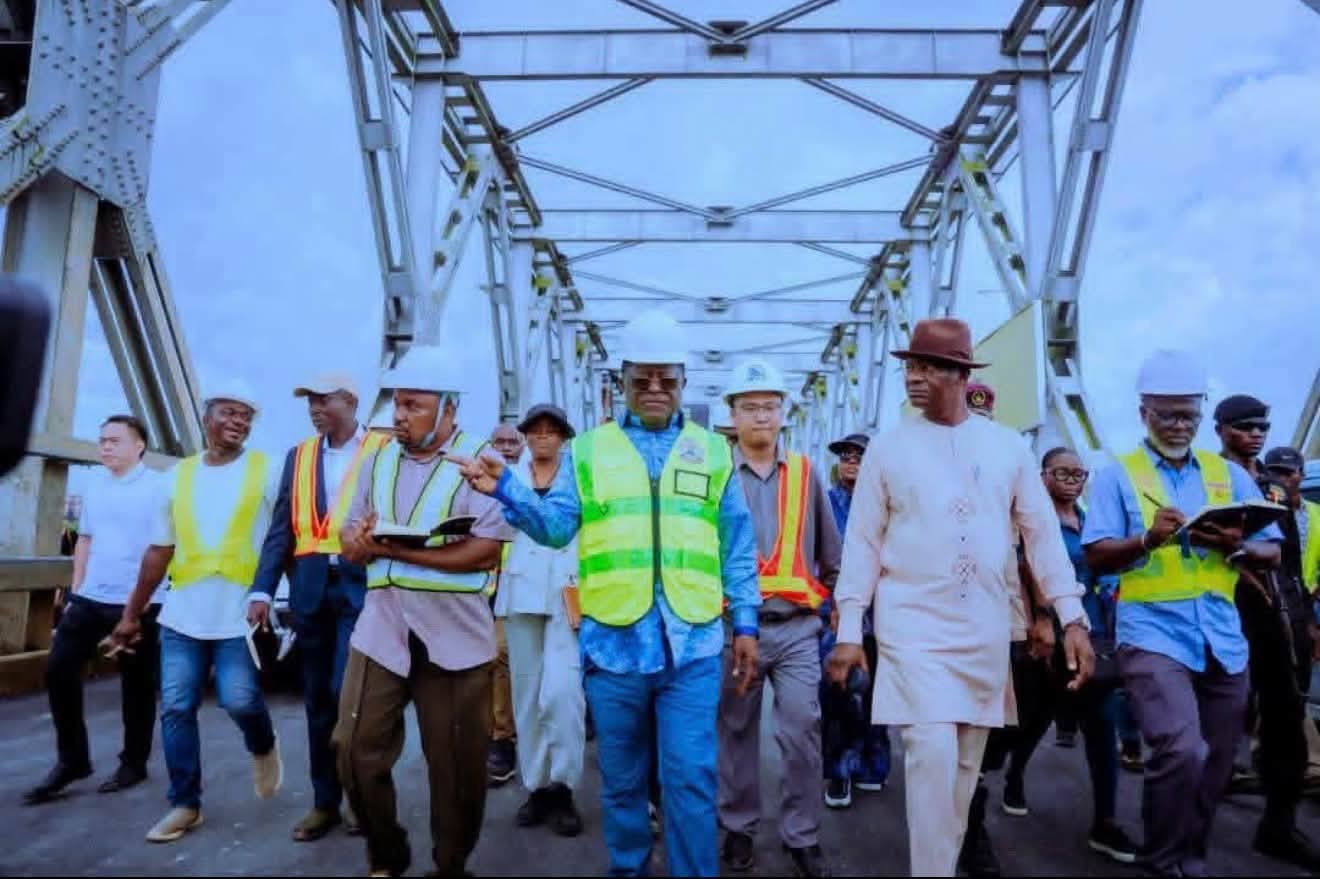
Minister of Works, David Umahi, has directed that only President Bola Tinubu’s photographs adorn the First Niger Bridge, immediately after rehabilitation work is completed.
Umahi, who inspected the bridge linking Anambra State and Delta State, also directed that all other political and commercial advertisements be cleared from the bridge and that the cleared space be reserved for Tinubu.
The directive has immediately raised questions over the distinction between prohibited commercial displays and politically favourable imagery on public infrastructure.
If unauthorised advertisements are considered an improper use of the bridge, the question is whether presidential photographs require a different regulatory specification simply because they carry the image of the nation’s president.
Recall that the bridge was closed to vehicular traffic on September 7, 2026, to allow contractors to execute the emergency works.
The rehabilitation includes the removal of the deteriorated asphalt surface, installation of a new approximately 40-millimetre wearing course, replacement and repair of damaged structural components, and the installation of solar streetlights and CCTV systems.
The original September 21 reopening target was pushed back by a week after persistent rainfall disrupted construction activities and affected some completed sections.
Following his September 23–24 inspection, Umahi said the bridge would reopen next week, subject to completion of critical works and safety certification.
Built by the French construction company Dumez following feasibility studies by Netherlands Engineering Consultants (NEDECO), the approximately 1,404-metre steel bridge was constructed principally between 1964 and 1965 and opened to traffic in December 1965.
It was commissioned by then Prime Minister Sir Abubakar Tafawa Balewa shortly before the political crisis that culminated in his assassination in January 1966.
The bridge subsequently endured the Nigerian Civil War, during which it was partially destroyed, before being repaired and returned to service.
For decades, it has remained one of Nigeria’s most important east-west transport corridors, carrying enormous volumes of commercial and passenger traffic between the South-East and South-South.
Its engineering history is therefore one of endurance, reconstruction and continuous maintenance.
But the current controversy is not about steel fatigue, asphalt failure or expansion-joint displacement.
It is about where public infrastructure ends and political messaging begins.
Umahi’s position creates an unusual visual equation: illegal advertisements are to be removed, yet the President’s photographs are to occupy the resulting space.
That distinction may require more explanation than the bridge’s expansion joints.
A public bridge is designed to carry traffic – not political branding. Its structural drawings specify dead loads, live loads, wind loads and safety factors; they do not ordinarily contain a political billboard schedule.
The government may legitimately determine what can be displayed on federal infrastructure. But where one category of display is removed as illegal, and another is permitted, the regulatory basis for that distinction becomes a legitimate matter of public scrutiny.
The engineers may be repairing the bridge’s physical load-bearing system. The government may now have to explain the political load it is asking the same bridge to carry.