



The Federal Government has announced that more than one million out-of-school children have been enrolled back into classrooms over the past two years through reforms aimed at expanding access to education across Nigeria.
Minister of Education, Dr Tunji Alausa, disclosed this on Wednesday at the 2026 Annual Education Summit of the Education Correspondents Association of Nigeria (ECAN) in Abuja. He also urged journalists to leverage official education data to hold governments at all levels accountable for improved service delivery.
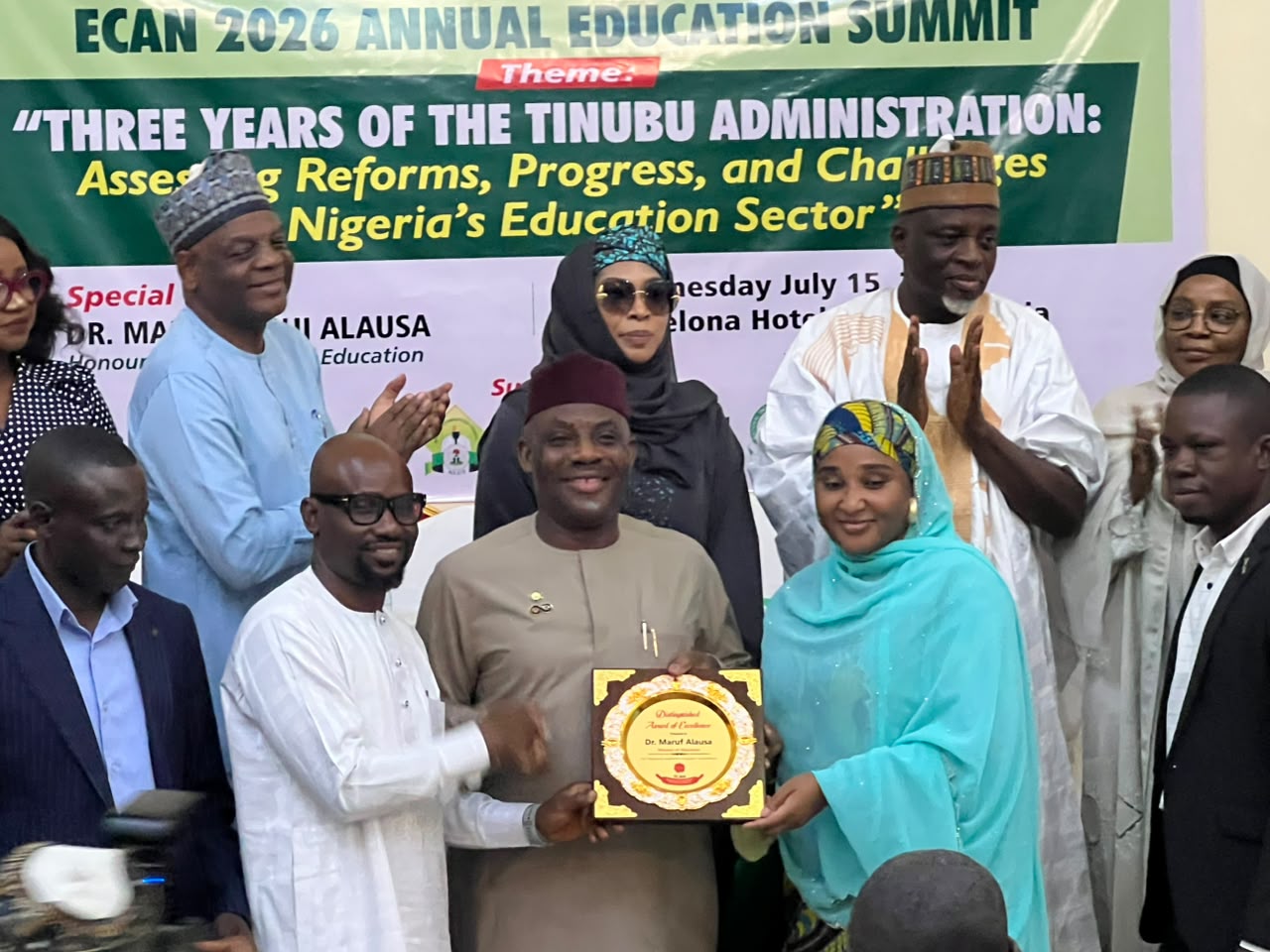
Addressing the summit, themed “Three Years of the Tinubu Administration: Assessing Reforms, Progress and Challenges in Nigeria’s Education Sector,” Alausa said the administration had recorded notable gains in increasing school enrolment through targeted interventions.
“In the last 24 months, we have moved over one million children off the streets into schools. Over one million,” he said.
While describing the achievement as significant, the minister acknowledged that millions of children remain outside the formal education system, stressing that credible data is essential for effective policymaking.
He revealed that the Federal Ministry of Education, in partnership with the National Bureau of Statistics (NBS), is conducting a nationwide household survey to establish the actual number of out-of-school children and provide evidence for future interventions.
Alausa identified limited access to junior secondary schools as a major contributor to the country’s education deficit, noting that Nigeria has approximately 90,000 primary schools but only about 16,000 junior secondary schools.
According to him, nearly 25 million pupils are enrolled in primary schools, while only about five million transition to junior secondary education.
“The ratio is one to eight. That tells you the major problem. The problem is access,” he stated.
The minister also challenged education correspondents to embrace data-driven reporting by utilising the Federal Ministry of Education’s Digitalised Nigeria Education Management Information System (DNEMIS), which provides comprehensive data on school enrolment, infrastructure, classrooms and teacher distribution nationwide.
“We need you journalists to use those data to challenge governors and local government authorities. You can now see the number of teachers, classrooms and facilities available in schools. You can drill down to the school level. This is using data for public good, and you are the mouthpiece of the nation,” he said.
He explained that preliminary findings from the 2024/2025 Annual School Census had exposed significant gaps in the transition from primary to junior secondary education, adding that the findings were already shaping government policy.
“We don’t make reforms based on assumptions. We make them based on data,” Alausa added.
The minister further highlighted key reforms under the Tinubu administration, including sustained industrial harmony in tertiary institutions, expansion of Technical and Vocational Education and Training (TVET), promotion of Science, Technology, Engineering and Mathematics (STEM), digital transformation initiatives, and improvements in university rankings.
Also speaking, the Minister of State for Education, Prof. Suwaiba Ahmad, said the reforms represented a deliberate effort to reposition Nigeria’s education sector rather than routine government activities.
“Change is never easy. But if you want different results, you have to change what you are doing,” she said, while urging Nigerians to remain patient as the reforms continue to take effect.
She noted that the Nigerian Education Sector Renewal Initiative (NESRI) is driving reforms in teacher development, curriculum review, digital learning, STEM education, technical and vocational training, quality assurance, and governance.
In her remarks, the Executive Secretary of the Universal Basic Education Commission (UBEC), Dr. Aisha Garba, reaffirmed the commission’s commitment to ensuring that every Nigerian child, irrespective of background or location, has access to quality basic education.
She described education as the most effective tool for national development and pledged continued collaboration with the media and other stakeholders to strengthen basic education across the country.
Earlier, ECAN Chairman, Mr. Chuks Ukwuatu, said the summit was organised to evaluate the achievements, reforms and persistent challenges in Nigeria’s education sector while fostering constructive engagement among policymakers, development partners and the media.
The event also featured the presentation of awards to the Minister of Education, the Executive Secretary of the Tertiary Education Trust Fund (TETFund), Arc. Sonny Echono, the Registrar of the Joint Admissions and Matriculation Board (JAMB), Prof. Ishaq Oloyede, the Executive Secretary of the National Universities Commission (NUC), Prof. Abdullahi Ribadu, the Registrar of the National Examinations Council (NECO), Prof. Dantani Wushishi, and other education sector leaders in recognition of their contributions to educational development in Nigeria.